
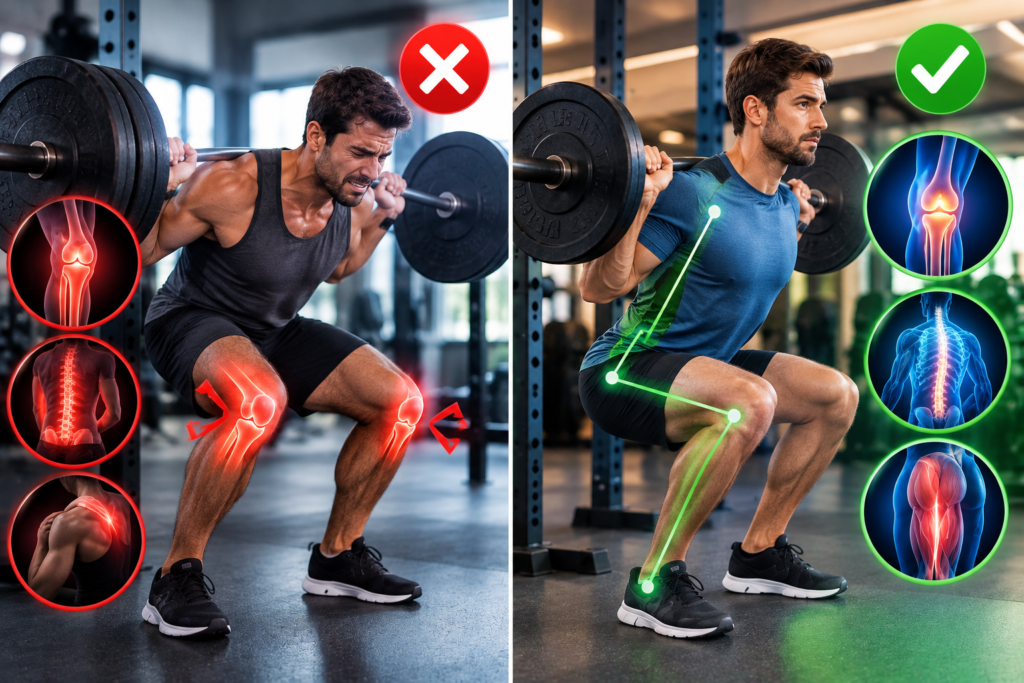
Do you train regularly, push hard on every set, but feel like the results just aren’t showing up?
Before assuming the problem is genetics or lack of dedication, it’s worth considering a factor a lot of people overlook: training with the wrong weight could be exactly what’s stalling your progress in the gym.
In this article, you’ll learn why using the right weight matters so much for results, how to tell if you’re getting it wrong, and what to do to fix it safely.
Why the Right Weight Matters So Much
A lot of people focus only on “training heavy” or “doing lots of reps,” without understanding that the ideal weight depends on your training goal.
Using the wrong weight can create two equally harmful scenarios:
- Too light: the stimulus isn’t enough to trigger muscle adaptation
- Too heavy: it compromises proper form, increasing injury risk
In other words, both too much and too little weight can sabotage your results.
Signs You’re Training With the Wrong Weight
1. You Finish Every Set Without Any Difficulty
If the last reps of each set feel “too easy,” the weight is probably too light to stimulate muscle growth.
2. You Can’t Complete Your Reps With Good Form
On the other hand, if your technique breaks down significantly on the last reps, the weight might be too heavy for your current level.
3. Stalled Progress
If you’ve been using the same weight for weeks (or months) with no progression, your body has already adapted to that stimulus — and it’s time to reassess.
4. Frequent Joint Pain
Inappropriate loads, especially ones that are too heavy, put extra strain on the joints, which can lead to discomfort and even injury.
How to Set the Right Weight for Each Goal
The ideal weight varies depending on what you’re trying to achieve with your training:
For Strength Gains
Higher weights with fewer reps (between 3 and 6) are generally used, prioritizing intensity.
For Hypertrophy (Muscle Growth)
Moderate weights with reps between 8 and 12 tend to be more effective for this goal.
For Muscular Endurance
Lighter weights with higher reps (above 15) are typically used.
Important: these numbers are general references. The ideal prescription should be individualized by a fitness professional, taking into account your history, fitness level, and specific goals.
The Concept of Controlled Muscle Failure
One of the best indicators that your weight is appropriate is what’s called “controlled muscle failure”: the feeling that you could do, at most, 1 or 2 more reps with good form by the end of the set.
This indicates the muscle was properly stimulated, without compromising the safety of the movement.
How to Adjust Your Weight in Practice
- Check your form: if technique breaks down on the last reps, reduce the weight
- Pay attention to perceived difficulty: the last reps should be challenging, but doable
- Progress gradually: small weight increases over time are safer than sudden jumps
- Reassess periodically: what was challenging a month ago might not be anymore
The Mistake of Comparing Your Weight to Other People’s
A common mistake is setting your weight based on what other people lift, ignoring your own fitness level.
This significantly increases injury risk and hurts your progress, since weight needs to be individualized, not compared.
The Importance of Professional Guidance
Adjusting weight safely and effectively requires an individualized assessment. A fitness professional can help:
- Determine the ideal weight for each exercise and goal
- Correct your movement technique
- Structure weight progression over time
- Significantly reduce injury risk
Conclusion: It’s Not About Training More, It’s About Training With the Right Weight
Frustration over lack of results often has nothing to do with lack of effort — it’s about using the wrong weight during training.
Fixing this detail could be exactly what was missing to unlock your progress in the gym.
Have you ever stopped to check whether you’re using the right weight in your workouts? Let us know in the comments!
If this helped you see this differently, share it with someone who might be making this same mistake. 🏋️♂️💪
This content is for informational purposes only and does not replace guidance from a fitness professional. Always consult a specialist for an individualized training prescription.
Leave a Reply