
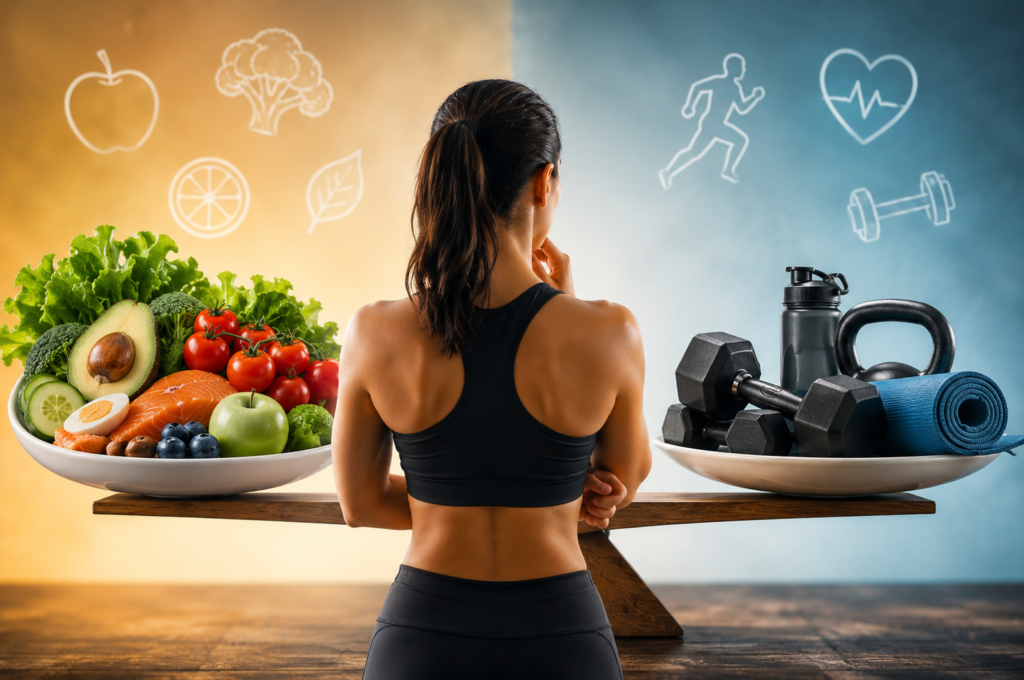
“Do I need to train more or eat less?” That’s probably one of the most common questions people ask when trying to lose weight.
The truth is, this question creates a lot of confusion — and sometimes frustration, when someone trains hard but doesn’t see the scale move.
In this article, you’ll finally understand the real role diet and exercise play in weight loss, and why this question might be framed the wrong way to begin with.
Why This Question Confuses So Many People
The idea that it’s “either diet or exercise” creates a competition that, in practice, doesn’t exist.
Weight loss isn’t about picking a side. It depends on the relationship between two factors working together: how many calories you consume and how many calories you burn.
The Role of Diet in Weight Loss
Here’s a direct point: it’s practically impossible to lose weight consistently without adjusting your diet.
That’s because it’s much easier to consume a calorie surplus than it is to burn off that same surplus through exercise.
Why Diet Tends to Weigh More on the Scale (Literally)
- A high-calorie food can be eaten in just a few minutes
- Burning those same calories through exercise can take much longer
- It’s easier to control what you eat than to compensate for excess through exercise
That’s why experts often say “weight loss starts in the kitchen.”
The Role of Exercise in Weight Loss
That doesn’t mean exercise is optional — quite the opposite.
Physical activity plays an essential role that goes beyond simple calorie burning:
- Preserves muscle mass during a calorie deficit
- Speeds up metabolism long-term, especially with strength training
- Improves body composition, not just the number on the scale
- Supports cardiovascular and mental health
- Helps maintain weight loss over the long run
In other words: diet is essential for creating the calorie deficit, but exercise is essential for that weight loss to happen in a healthy, sustainable way.
Diet vs. Exercise: Comparing the Two Factors
| Factor | Main Impact |
|---|---|
| Diet | Creates the calorie deficit needed to lose weight |
| Exercise | Preserves muscle, speeds up metabolism, and improves overall health |
Notice that both play different — and complementary — roles. It doesn’t make sense to choose just one.
Why Just Training (Without Adjusting Your Diet) Usually Doesn’t Work
A very common mistake is thinking that training hard “earns” you the right to eat without control.
In practice, it’s easy to eat, in just a few minutes, the calorie equivalent of an entire hour of training.
This is one of the main reasons so many people train a lot but don’t lose weight.
Why Just Dieting (Without Exercising) Also Has Limitations
Losing weight through food restriction alone, without physical activity, can lead to consequences like:
- Losing muscle mass along with fat
- A drop in basal metabolic rate over time
- Greater difficulty maintaining weight loss
- Less muscle definition, even after losing weight
So, What Really Matters for Weight Loss?
The most honest answer is: both factors matter, just in different roles.
- Diet determines whether you’ll lose weight (through the calorie deficit)
- Exercise determines how that weight loss happens (with or without preserving muscle, with or without long-term sustainability)
How to Combine Diet and Exercise Strategically
- Adjust your diet to create a moderate, sustainable calorie deficit
- Include strength training to preserve muscle mass
- Add cardio strategically, without overdoing it
- Prioritize protein in your diet, which helps with satiety and muscle preservation
- Be consistent, more than perfect
Conclusion: It’s Not Diet OR Exercise — It’s Diet AND Exercise
The question “diet or exercise” starts from a flawed premise. Healthy, sustainable weight loss depends on smartly combining both.
Diet creates the conditions for weight loss to happen. Exercise ensures that process happens in the healthiest way possible.
Do you feel like you already balance diet and exercise well, or do you tend to focus more on one of the two? Let us know in the comments!
If this helped you better understand this relationship, share it with someone who has the same question. 🥗🏋️♀️
This content is for informational purposes only and does not replace guidance from a registered dietitian or fitness professional. Always consult a specialist before making changes to your diet or exercise routine.
Leave a Reply