
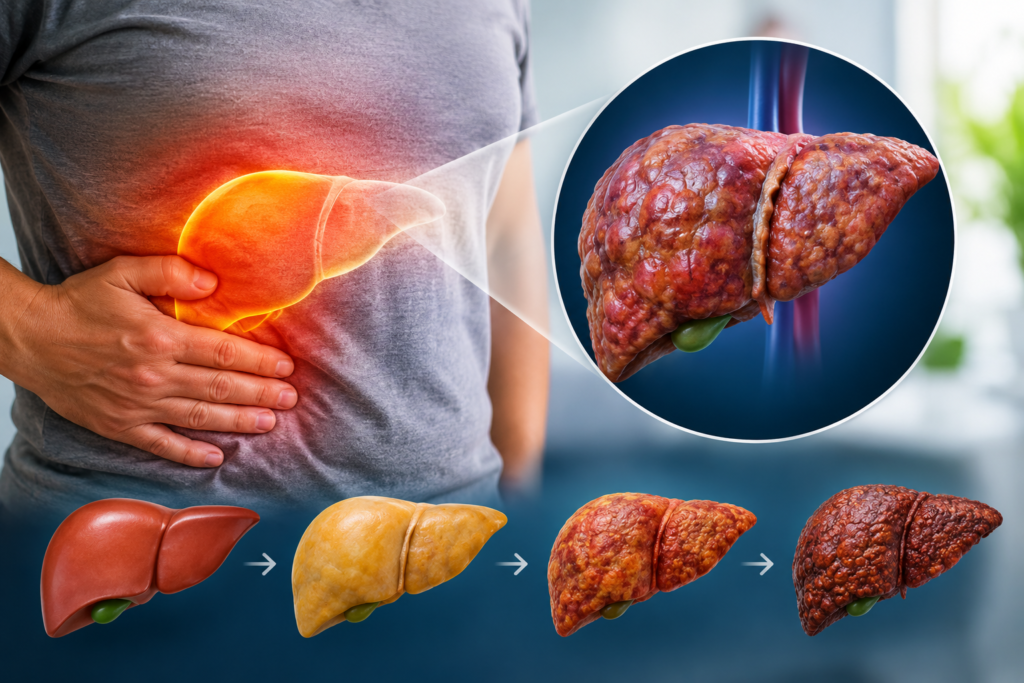
Did you know your liver can struggle for years without giving you almost any warning? That’s why fatty liver disease (hepatic steatosis) is often called a “silent disease”: in most cases, it only shows clear signs once the condition has already advanced.
In this article, you’ll learn:
- What silent sign tends to appear only after liver scarring (fibrosis) has already developed;
- Why abdominal swelling is a symptom that deserves extra attention;
- What other signs can show up alongside it, and what to do next.
Let’s break it down simply, no complicated medical jargon. 😊
What Exactly Is Fatty Liver Disease?
Fatty liver disease happens when fat cells build up in the liver beyond normal levels. This can happen for several reasons: a diet high in sugar and fat, a sedentary lifestyle, excess weight, insulin resistance, alcohol consumption, and other factors.
In the early stages, the liver barely complains. It’s an organ that “suffers in silence” — and that’s exactly what makes this disease so tricky: many people only discover they have fatty liver during a routine checkup, without feeling anything at all.
The Silent Sign: When the Body Finally Speaks Up (Too Late)
Over time, if fatty liver disease isn’t treated, it can progress to inflammation (steatohepatitis) and later to fibrosis — a type of “scarring” that forms in the liver tissue.
Here’s the real issue: many of the more noticeable symptoms only show up once this scarring has already reached an advanced stage. In other words, the body can stay silent for years before sending a clearer signal.
Among these later-stage signs, one of the most common is abdominal swelling, which we’ll explain in more detail below.
Why Is This Concerning?
Because it means that by the time symptoms become more visible, the liver may already be significantly compromised — which calls for prompt medical attention. This is exactly why routine checkups (even without symptoms) matter so much, especially for people with risk factors like being overweight, having diabetes, or high cholesterol.
Why Abdominal Swelling Is So Concerning
Abdominal swelling (medically known as ascites) happens when fluid builds up in the belly area. This can occur because a severely compromised liver partially loses its ability to:
- Produce important proteins that help regulate fluid balance in the body;
- Control blood pressure in the vessels that pass through the liver.
When this happens, fluid “leaks” into the abdominal cavity, causing swelling that can:
- Noticeably increase over the course of days or weeks;
- Come with a feeling of heaviness or discomfort in the belly;
- Make it harder to take deep breaths, in more severe cases.
This type of swelling shouldn’t be ignored. Unlike temporary bloating from poor digestion, ascites is usually persistent and tends to worsen over time, making it an important warning sign to seek medical evaluation as soon as possible.
Other Signs That Can Show Up Alongside It
Abdominal swelling rarely shows up on its own. Watch out if, along with it, you also notice:
- Unusual fatigue, even without intense physical effort;
- Yellowing of the skin or eyes (jaundice);
- Itchy skin, with no obvious cause;
- Swelling in the legs and ankles;
- Small red, spider-like blood vessels on the skin (spider angiomas);
- Easy bruising or bleeding;
- Mild mental confusion, forgetfulness, or trouble concentrating.
None of these signs alone necessarily means something serious. But when they show up together — especially abdominal swelling combined with fatigue or yellowing skin — it’s time to see a doctor as soon as possible.
What Should You Do If You Notice These Signs?
If you recognized any of these symptoms in yourself or someone close to you, the most important next step is simple:
👉 See a hepatologist or gastroenterologist for a full evaluation. Blood tests, an ultrasound, and in some cases liver elastography (a test that measures the degree of fibrosis) can help pinpoint exactly where things stand.
In the meantime, some everyday habits that help protect your liver include:
- Cutting back on sugar and ultra-processed foods;
- Exercising regularly;
- Maintaining a healthy weight;
- Avoiding alcohol consumption;
- Getting routine checkups, even without symptoms.
Final Thoughts
Fatty liver disease is common, but it deserves to be taken seriously: it can progress silently, and some of its clearest signs only appear once the condition is already advanced. Paying attention to abdominal swelling and the symptoms that often accompany it can make all the difference in getting help in time.
If you recognized yourself in any of these signs, don’t put it off: schedule an appointment with a healthcare professional. Taking care of your liver today means taking care of your quality of life tomorrow. 💛
This article is for informational purposes only and is not a substitute for medical advice. Always consult a qualified healthcare professional for diagnosis and guidance specific to your situation.
Leave a Reply